

Businesses across the UAE are under increasing pressure to improve operational efficiency. Ajman, one of the fastest-growing emirates for manufacturing and trade, is no exception. Working with a NetSuite ERP partner in Ajman helps companies centralise operations, meet VAT compliance requirements, and scale without adding headcount. According to a 2023 Gartner report, organisations that implement cloud ERP see an average 21% improvement in process efficiency within the first year. This post covers which industries in Ajman benefit most from NetSuite ERP and exactly why.
Which Industries Benefit Most from NetSuite ERP in the UAE?
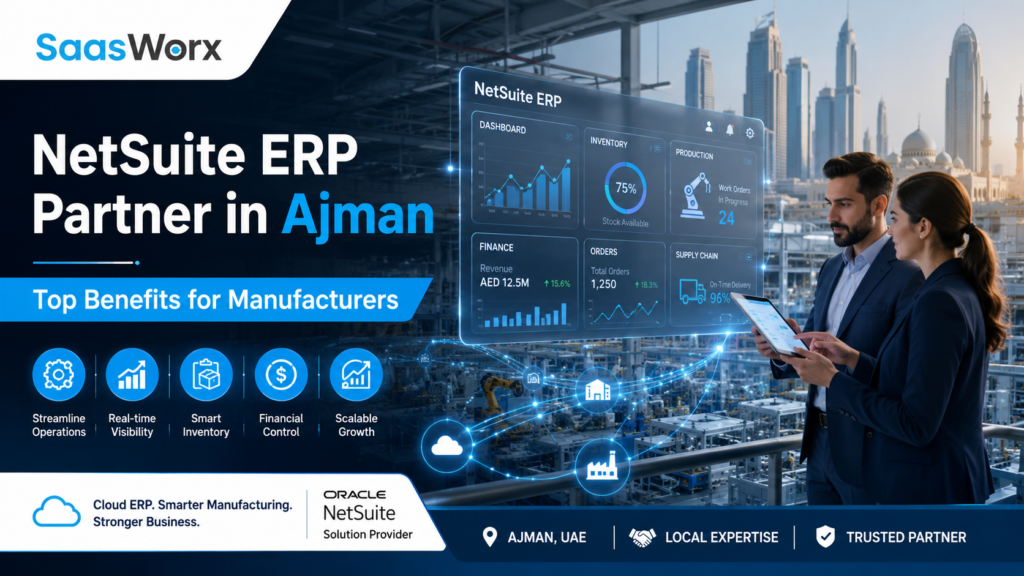
Manufacturing, wholesale distribution, retail, and professional services companies in Ajman benefit most from NetSuite ERP. These sectors deal with high transaction volumes, multi-location operations, and complex compliance requirements all areas where ERP creates measurable impact.
Manufacturing Companies in Ajman
Manufacturing is Ajman’s dominant sector. The emirate hosts over 700 factories across textiles, food processing, chemicals, and metals. Managing production schedules, raw material procurement, and export documentation manually creates costly errors.
NetSuite ERP connects production planning, inventory, and financials in a single system. Manufacturers can track work-in-progress in real time, set automated reorder points, and generate FTA-compliant VAT reports without manual data entry. For factories operating across multiple shifts or facilities, visibility into live production data is a direct operational advantage.
Wholesale and Trading Companies
Ajman’s proximity to Sharjah and Dubai makes it a strategic hub for import-export and wholesale trading. Trading companies manage large SKU catalogues, multiple suppliers, and tight margins a combination that overwhelms spreadsheet-based systems quickly.
With NetSuite, trading firms get real-time landed cost calculations, multi-currency purchase orders, and automated three-way matching for invoices. That eliminates reconciliation delays and reduces the risk of overpaying suppliers.
What Does a NetSuite ERP Partner Do?
A NetSuite ERP partner handles implementation, configuration, data migration, staff training, and post-go-live support. They map your existing processes to NetSuite’s modules, customise workflows to fit your industry, and ensure the system meets UAE regulatory requirements from day one.
VAT and FTA Compliance Setup
UAE businesses must file VAT returns and maintain audit-ready financial records under Federal Tax Authority rules. A qualified ERP partner configures tax codes, filing periods, and report formats so the system produces FTA-compliant outputs automatically. This removes manual compliance work and reduces filing errors.
Data Migration and System Integration
Most businesses moving to NetSuite have years of data in disconnected systems accounting software, spreadsheets, or legacy ERP platforms. A partner manages the migration process: cleaning data, mapping fields, running test imports, and validating outputs before go-live. They also integrate NetSuite with existing tools like e-commerce platforms or logistics systems.
For businesses evaluating implementation options, this resource on working with a NetSuite ERP partner in Ajman outlines what the process involves for UAE-based companies.
Is NetSuite ERP Suitable for Small Businesses in Ajman?
Yes. NetSuite offers tiered pricing and modular implementation, which means small businesses only pay for what they need. Companies with 10–50 employees in trading, retail, or services regularly implement NetSuite in Ajman. According to Forrester Research (2022), cloud ERP adoption among SMEs in the Middle East grew by 34% year-on-year, driven by falling implementation costs and faster deployment timelines.
Retail and E-Commerce Businesses
Retail businesses in Ajman managing both physical outlets and online stores face inventory synchronisation problems. A product sold in-store must immediately update online stock something manual systems cannot do reliably. NetSuite’s inventory module handles this in real time across all channels.
E-commerce brands also benefit from NetSuite’s native order management. Returns, refunds, and fulfilment updates flow directly into the financial ledger, cutting reconciliation time significantly.
Professional Services Firms
Consultancies, IT firms, and project-based businesses in Ajman deal with resource allocation, project billing, and revenue recognition. NetSuite’s project management module tracks time, expenses, and project profitability in one place. Firms can bill clients accurately, recognise revenue per contract terms, and forecast resource availability without using separate tools for each function.
Conclusion
Ajman’s industrial base manufacturing, trading, retail, and services maps directly onto NetSuite’s core strengths. A NetSuite ERP partner in Ajman brings the technical knowledge to configure the system for UAE compliance requirements, reduce implementation risk, and shorten the path to operational value. As Ajman continues to attract investment and expand its free zone ecosystem, companies that standardise on cloud ERP now will be better positioned to scale. The real question is not whether ERP is right for your industry it is how long you can afford to operate without it.
Leave a Comment