
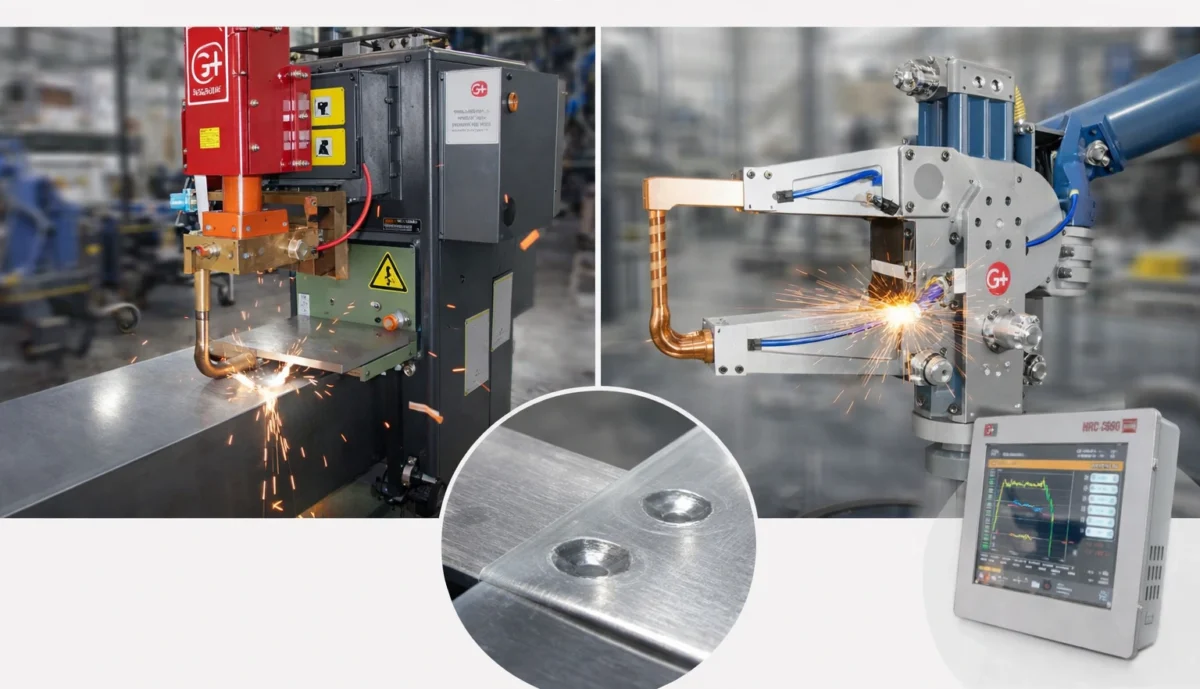

In today’s high-speed manufacturing environment, joining metal parts with consistency, strength, and efficiency is essential for competitive production. A spot resistance welder is one of the most widely used technologies in automotive, appliance, electrical, and sheet metal fabrication industries due to its speed, repeatability, and low operating cost.
For OEMs, automation integrators, and factory engineers, understanding how a spot resistance welder works and how to select the right system can significantly improve production quality and throughput. This article explores the working principle, applications, advantages, and best practices of spot resistance welding, along with how advanced solutions from Heron Welder support modern industrial needs.
What is a Spot Resistance Welder?
A spot resistance welder is a type of resistance welding equipment used to join two or more overlapping metal sheets by applying pressure and passing an electric current through the contact point.
The heat generated by electrical resistance melts the metal at a localized “spot,” forming a strong weld nugget after cooling under pressure.
Unlike traditional welding methods, spot resistance welding does not require filler material or shielding gas, making it highly efficient for mass production environments.
Working Principle of Spot Resistance Welding
The operation of a spot resistance welder is based on Joule heating (I²R principle), where heat is generated when electrical current passes through resistance at the contact interface.
Step-by-step process:
- Electrode Clamping
Two copper alloy electrodes press the metal sheets together with controlled force. - Current Application
A high electrical current is passed through the electrodes and workpieces. - Heat Generation
Resistance at the interface produces heat, melting the metal at the contact point. - Weld Nugget Formation
The molten metal forms a fusion zone between the sheets. - Cooling Under Pressure
The current stops, but pressure is maintained until the weld solidifies.
This process takes milliseconds, making spot welding ideal for high-volume production lines.
Key Components of a Spot Resistance Welder
A modern spot resistance welder system typically includes:
1. Welding Transformer
Converts electrical input into low voltage, high current output required for welding.
2. Electrode System
Copper-based electrodes apply force and deliver current precisely to the weld area.
3. Welding Controller
Controls current intensity, weld time, squeeze time, and cooling cycle for precision welding.
4. Pneumatic or Servo Force System
Applies consistent electrode force, ensuring weld quality and repeatability.
5. Cooling System
Maintains electrode and transformer temperature for continuous operation.
Advanced systems, such as those developed by Heron Welder, integrate MFDC (Medium Frequency Direct Current) technology for improved energy efficiency and weld stability.
Industrial Applications of Spot Resistance Welder
The spot resistance welder is widely used across industries that require strong and repeatable sheet metal joints.
Automotive Industry
- Car body panels
- Door assemblies
- Battery trays for EVs
- Structural reinforcements
Appliance Manufacturing
- Washing machine drums
- Refrigerators and freezers
- Microwave housings
Electrical & Electronics
- Metal enclosures
- Busbars and connectors
- Control cabinets
Metal Fabrication
- Steel furniture
- HVAC ducting systems
- Industrial enclosures
Its versatility makes it a core technology in automated production lines worldwide.
Advantages of Spot Resistance Welding
Using a spot resistance welder offers multiple operational and economic benefits:
High Production Speed
Welding cycles take milliseconds, enabling mass production with minimal downtime.
Cost Efficiency
No filler materials, flux, or shielding gases are required.
Automation Compatibility
Easily integrates into robotic arms and automated production lines.
Clean and Precise Welding
Produces minimal spatter and requires little post-processing.
Strong Mechanical Joints
Creates durable weld nuggets suitable for structural applications.
Energy Efficient Systems
Modern MFDC-based spot welders optimize power consumption while improving weld consistency.
Spot Resistance Welder vs Other Welding Methods
Understanding how spot welding compares with other joining methods helps engineers select the right solution.
Spot Welding vs MIG Welding
- Spot welding: faster, cleaner, ideal for thin sheets
- MIG welding: better for thick materials and continuous seams
Spot Welding vs Laser Welding
- Spot welding: lower cost, easier maintenance
- Laser welding: higher precision but expensive equipment
Spot Welding vs Riveting
- Spot welding: permanent and faster
- Riveting: mechanical fastening, but slower and bulkier
For high-volume sheet metal production, spot resistance welding remains one of the most cost-effective solutions.
Key Selection Factors for Spot Resistance Welder
Choosing the right system requires careful evaluation of production requirements:
Material Type and Thickness
Different metals (steel, stainless steel, aluminum) require different current and force settings.
Duty Cycle Requirements
Continuous production lines require high-duty, water-cooled systems.
Automation Level
Robotic or semi-automated systems require programmable controllers and integration support.
Welding Force and Current Range
Higher force ensures stronger welds for thicker materials.
Energy Efficiency
MFDC inverter-based systems reduce power consumption and improve weld control.
Best Practices for Optimal Welding Performance
To ensure consistent results from a spot resistance welder, manufacturers should follow these practices:
- Regular electrode cleaning and dressing
- Proper alignment of electrode tips
- Calibration of welding current and time settings
- Monitoring electrode wear and replacing when necessary
- Maintaining cooling systems to prevent overheating
- Using material-specific welding parameters
Proper maintenance significantly improves weld quality and extends machine lifespan.
Heron Welder: Advanced Spot Resistance Welding Solutions
Heron Welder is a global manufacturer specializing in advanced resistance welding and metal joining systems, designed for modern industrial automation.
Their spot resistance welder solutions are engineered for:
- High-precision welding in automotive production lines
- Energy-efficient MFDC inverter technology
- Integration with robotic automation systems
- Stable performance under continuous production cycles
- Custom-engineered welding solutions for OEMs
Heron’s expertise extends beyond standard machines, offering complete welding production line solutions including welding guns, controllers, clinching systems, and self-piercing riveting (FSPR) technologies.
For manufacturers aiming to improve weld consistency, reduce cycle time, and enhance production reliability, Heron provides tailored solutions designed for industrial-scale performance.
FAQs About Spot Resistance Welder
1. What materials can a spot resistance welder join?
It is commonly used for low-carbon steel, stainless steel, coated steels, and certain aluminum alloys, depending on machine capacity.
2. Is spot welding suitable for thick metals?
Spot welding is most effective for thin to medium sheet metals. For thicker materials, higher current systems or alternative welding methods may be required.
3. How long does a spot weld take?
A typical weld cycle takes between a few milliseconds to a second, depending on material and thickness.
4. What industries use spot resistance welders the most?
Automotive, appliance manufacturing, HVAC systems, electrical enclosures, and metal fabrication industries widely use this technology.
5. How do I improve weld quality in spot welding?
Consistent electrode maintenance, correct parameter settings, and stable force application are key factors for improving weld quality.
Conclusion
A spot resistance welder is a critical tool in modern manufacturing, offering speed, precision, and cost efficiency for sheet metal joining applications. Its ability to deliver consistent welds at high production rates makes it indispensable in automotive and industrial production lines.
As manufacturing demands continue to evolve toward automation and energy efficiency, advanced systems like those offered by Heron Welder play a vital role in improving productivity and welding performance.
Request a Custom Welding Solution
If you are looking to improve production efficiency, reduce welding defects, or integrate automated welding systems into your manufacturing line, Heron Welder can provide a customized solution tailored to your requirements.
Contact their engineering team to discuss your application and request a professional consultation for advanced spot resistance welding systems.
Leave a Comment