

Contract manufacturing alcohol in India lets a brand owner produce spirits, beers, or wines at a licensed third-party facility without owning a distillery. This model has fuelled India’s rapid growth in regional and premium liquor brands, particularly since state excise reforms opened new corridors for independent label owners. India is now the world’s largest whisky market by volume, consuming over 200 million cases annually. For entrepreneurs and mid-size companies who want a slice of that market, contract manufacturing is the most practical and cost-effective entry route.
This post explains how contract manufacturing alcohol in India works, what licences you need, how to manage quality and compliance, and what realistic costs and timelines look like.
What Is Contract Manufacturing in the Alcohol Industry?
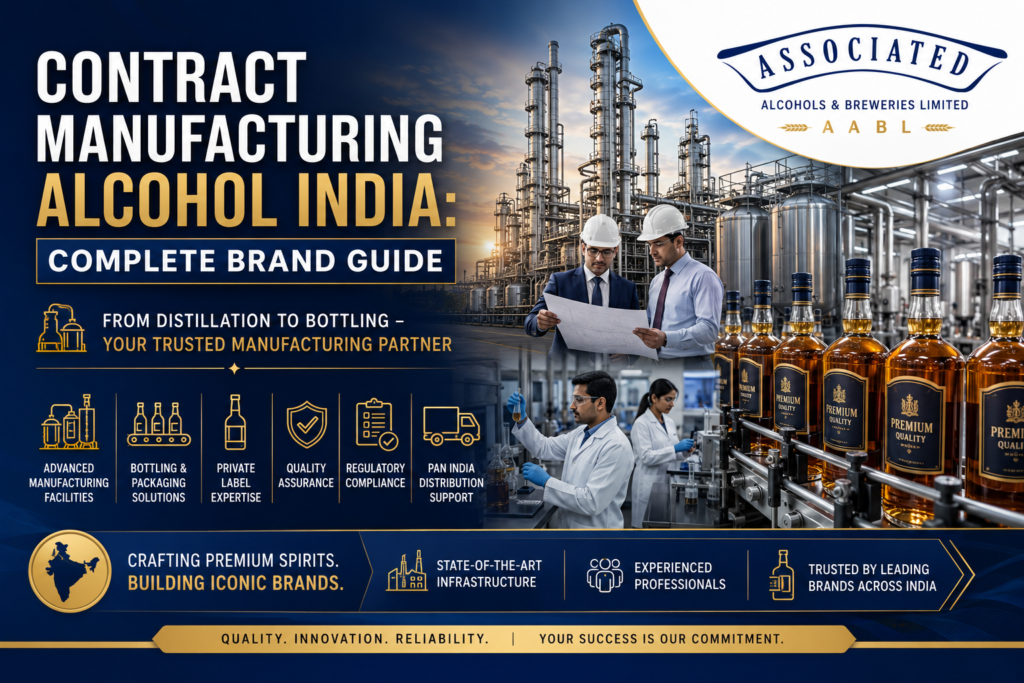
Contract manufacturing in the alcohol industry means a brand owner hires a licensed distillery or bottling unit to produce their product under the brand owner’s label. The manufacturer supplies the facility, equipment, raw materials, and production expertise. The brand owner owns the formulation, brand identity, and distribution rights.
This arrangement separates brand building from capital-intensive plant ownership. A brand owner does not need to invest in land, distillation columns, storage tanks, or bottling lines. The contract distillery bills per case produced or on a fixed-cost-per-batch model.
How Is This Different from a Private Label?
A private label arrangement means the manufacturer already has a product a recipe, a formula, a ready blend and the brand owner simply puts their label on it. Contract manufacturing goes further: the brand owner specifies the formulation, taste profile, and packaging. The manufacturer executes to spec. This distinction matters for premium positioning, because a bespoke formulation is harder for competitors to replicate than a shared private label blend.
Which Product Categories Are Available?
Contract manufacturing in India covers IMFL whisky, rum, brandy, vodka, and gin. Several licensed units also handle beer through contract brewing arrangements. Craft spirits single malts, artisan gins, and flavoured spirits are increasingly available through specialist contract distilleries in states like Goa, Maharashtra, Telangana, and Rajasthan.
What Licences Are Required for Contract Alcohol Manufacturing in India?
Alcohol is a state subject under the Indian Constitution, which means every state has its own excise policy and its own licensing structure. There is no single national licence that covers contract manufacturing across all states. You need compliance in the state where the manufacturing unit operates and in every state where you plan to sell.
Licences Needed by the Brand Owner
The brand owner typically needs a Brand Registration in the manufacturing state, an Import Permit or Inter-State Transport Permit for states where the product will be sold, and a Label Approval from the state excise authority in each target market. Some states also require a Wholesale Licence or a separate Distribution Agreement with a state-owned corporation.
Licences Held by the Manufacturer
The contract distillery must hold a Manufacturing Licence, an ENA Procurement Licence (for IMFL), and clearances under the FSSAI Act. Before signing any agreement, verify that the facility holds valid licences and that their annual licence renewal is current. A lapsed licence can halt your entire production batch mid-cycle.
Which States Have Favourable Policies?
Telangana, Rajasthan, Goa, Uttarakhand, and Himachal Pradesh have reputations for more transparent contract manufacturing frameworks. States with government monopoly retail such as Tamil Nadu, Kerala, and West Bengal have stricter listing requirements that can slow your go-to-market significantly. Always study the target state’s excise policy before choosing your manufacturing location.
How Long Does It Take to Launch a Liquor Brand Through Contract Manufacturing?
A realistic minimum timeline from brand registration to first commercial sale is six to nine months. Regulatory approvals are the primary bottleneck, not production. Label approvals in some states can take eight to twelve weeks alone.
Typical Phase Breakdown
The first phase covers manufacturer selection, formulation development, and signing the contract manufacturing agreement typically four to eight weeks. The second phase covers brand and label registration, state excise approvals, and inter-state permit applications eight to sixteen weeks depending on the states involved. The third phase covers first production run, quality checks, and dispatching trial stock four to six weeks. Build buffer time into every phase. Excise departments routinely ask for additional documentation without advance notice.
What Speeds Up the Process?
Working with a contract manufacturer who has existing relationships with state excise departments can cut approval timelines by two to four weeks. Manufacturers who already have your product category on their approved product list reduce formulation approval time. Using a regulatory consultant familiar with the target states is money well spent for first-time brand owners.
What Does Contract Manufacturing Alcohol in India Cost?
Contract manufacturing costs in India vary significantly by state, product category, volume commitment, and packaging format. A broadly indicative range for IMFL whisky in a standard 750ml glass bottle runs from Rs. 120 to Rs. 250 per case for manufacturing and bottling alone, excluding ENA cost, excise duty, and packaging materials. These figures are illustrative actual quotes will depend on your specific formulation and volume.
Key Cost Components
ENA (Extra Neutral Alcohol) is typically the single largest input cost and is priced by the bulk litre. Glass bottles, closures, and labels are sourced separately and can account for 30 to 40 percent of total packaging cost. Manufacturing fees cover blending, bottling, labelling, and case packing. Excise duty is levied state-by-state and varies enormously this is a cost that brand owners often underestimate at the planning stage.
Minimum Order Quantities
Most contract distilleries set minimum batch sizes of 500 to 1,000 cases per production run. Smaller runs are possible but attract a premium per-case cost. As volumes scale, manufacturers typically offer tiered pricing. An external resource covering detailed contract manufacturing structures and what to look for in a manufacturing agreement is available at
An external resource covering detailed contract manufacturing structures and what to look for in a manufacturing agreement is available at this overview of contract manufacturing for liquor brands it outlines the production process, compliance requirements, and key contractual terms in plain language.
How Do You Manage Quality in a Contract Manufacturing Setup?
Quality management in contract manufacturing depends entirely on the standards you build into the agreement before production begins. A contract that does not specify input quality standards, batch testing protocols, and rejection criteria gives you very limited recourse if the product falls short.
What to Include in a Quality Agreement
A robust contract manufacturing quality agreement should specify ENA source and grade, water treatment standards, blending ratios and tolerances, in-process test checkpoints, finished product sensory and chemical standards, and retention samples for every batch. Third-party lab testing either by an accredited NABL lab or an internationally recognised testing house adds a layer of verification independent from the manufacturer’s own QC team.
How Do You Protect Your Formulation?
Register your formulation with the state excise authority as part of the brand registration process. Include a non-disclosure and non-compete clause in your manufacturing agreement that prevents the manufacturer from producing a competing product using your recipe. Regularly audit the facility unannounced visits are a standard practice for serious brand owners.
Conclusion
Contract manufacturing alcohol in India is the most direct route to market for emerging liquor brands. It removes the capital barrier of building a distillery and lets a brand owner focus on product, positioning, and distribution. The critical variables are regulatory understanding state excise policy, securing the right licences, and building compliance into your timeline before you commit to a launch date.
The Indian spirits market is expanding beyond its traditional whisky and rum base, with premiumisation accelerating across categories. That creates real opportunity for new entrants who get the contract manufacturing fundamentals right. The question worth asking is not whether contract manufacturing is viable it clearly is but whether you have the regulatory knowledge and the right manufacturing partner to make it work.
Leave a Comment