
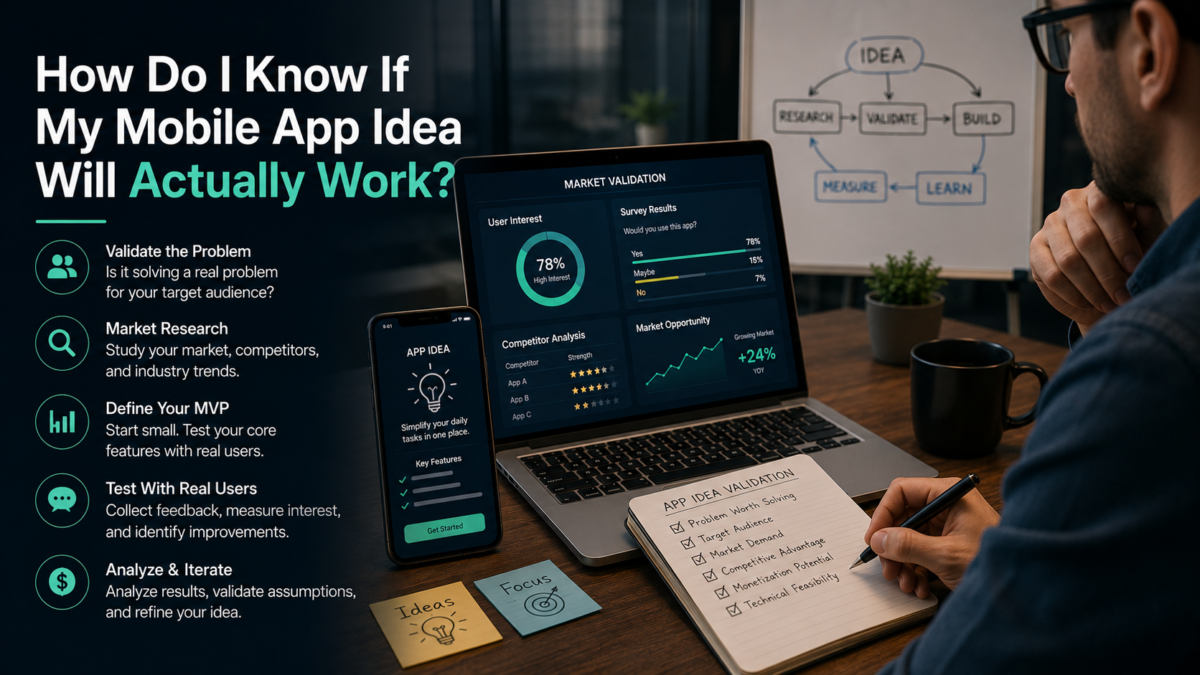

Every app starts with a moment of excitement.
Maybe you noticed a problem people complain about repeatedly. Maybe you thought of a faster way to do something. Or perhaps you spotted a gap in an existing market and believe you can fill it.
The challenge is that a good idea doesn’t automatically become a successful app.
Many founders approach a mobile app development company with confidence in their concept, only to discover that market demand is harder to predict than expected. The good news is that you don’t need to build a complete product before finding out whether your idea has potential.
Here are a few practical ways to validate your app idea before investing significant time and money.
Start With The Problem, Not The App
A surprising number of apps fail because they focus on features instead of problems.
Ask yourself a simple question:
What specific problem does this app solve?
If the answer is vague, users may struggle to understand why they need it.
The strongest apps usually solve an existing frustration. Think about ride-sharing, food delivery, fitness tracking, or expense management. People were already looking for solutions before those apps arrived.
If your idea addresses a real pain point, you’re already moving in the right direction.
Research Existing Apps
Many entrepreneurs worry about competition. In reality, competitors can be useful.
Existing apps prove that there is at least some demand in the market.
Look through:
- App Store reviews
- Google Play reviews
- Reddit discussions
- Industry forums
- Social media conversations
Pay attention to complaints. Negative reviews often reveal opportunities that competitors haven’t addressed.
Sometimes the best app ideas come from improving something that already exists rather than inventing something entirely new.
Define Your Target User
« Everyone » is not a target audience.
The more specific you become, the easier it is to evaluate whether your idea solves a meaningful problem.
Consider questions like:
- Who will use the app?
- How old are they?
- What challenges do they face?
- How often will they need the solution?
An app designed for busy parents will look very different from one designed for college students or healthcare professionals.
Specific audiences create clearer opportunities.
Talk To Real People
Many founders spend months planning without speaking to potential users.
That’s risky.
Find people who fit your target audience and ask about their current habits.
Instead of asking:
« Would you use this app? »
Ask:
- How do you currently solve this problem?
- What’s frustrating about the process?
- Have you paid for a solution before?
- What would make your life easier?
You’ll learn far more from honest conversations than from assumptions.
Build A Simple MVP
You don’t need a full-featured application to test demand.
A Minimum Viable Product (MVP) focuses on one core function.
Nothing fancy.
No unnecessary features.
Just enough to see how users respond.
An MVP helps answer critical questions:
- Will people download it?
- Will they come back?
- Do they find value in it?
- Would they recommend it?
Many successful startups began with surprisingly simple products.
Test Interest Before Development
Here’s something many founders overlook.
You can validate an app idea before writing code.
Try creating:
- A landing page
- A waitlist
- A simple survey
- A social media campaign
If nobody signs up, that tells you something important.
If people are willing to join a waitlist or provide their email address, that’s an encouraging signal that interest exists.
It’s not proof of success, but it’s useful evidence.
Consider The Business Model Early
Some apps attract users but struggle to generate revenue.
Before development begins, think about how the app will make money.
Common options include:
- Subscriptions
- In-app purchases
- Advertising
- Transaction fees
- Premium features
Understanding your monetization strategy early can help avoid expensive changes later.
It’s also an important factor when estimating overall mobile app development cost, especially if your app requires payment processing, memberships, or advanced backend systems.
Watch For Positive Signals
No validation method is perfect.
Instead of looking for certainty, look for patterns.
Positive indicators often include:
- Strong user feedback
- Consistent interest
- Waitlist signups
- Repeat usage during testing
- Willingness to pay
When multiple signals point in the same direction, confidence grows.
That’s usually a better approach than relying on intuition alone.
Final Thoughts
No one can guarantee that a mobile app idea will succeed. Even experienced founders get it wrong sometimes.
What separates successful projects from unsuccessful ones is often validation. The founders who talk to users, study competitors, test demand, and launch small versions of their ideas tend to make better decisions.
Before investing heavily in development, gather evidence.
If real people have a real problem and your app offers a solution they genuinely want, you’ll have something much more valuable than a great idea. You’ll have a foundation for a viable product.
Leave a Comment