
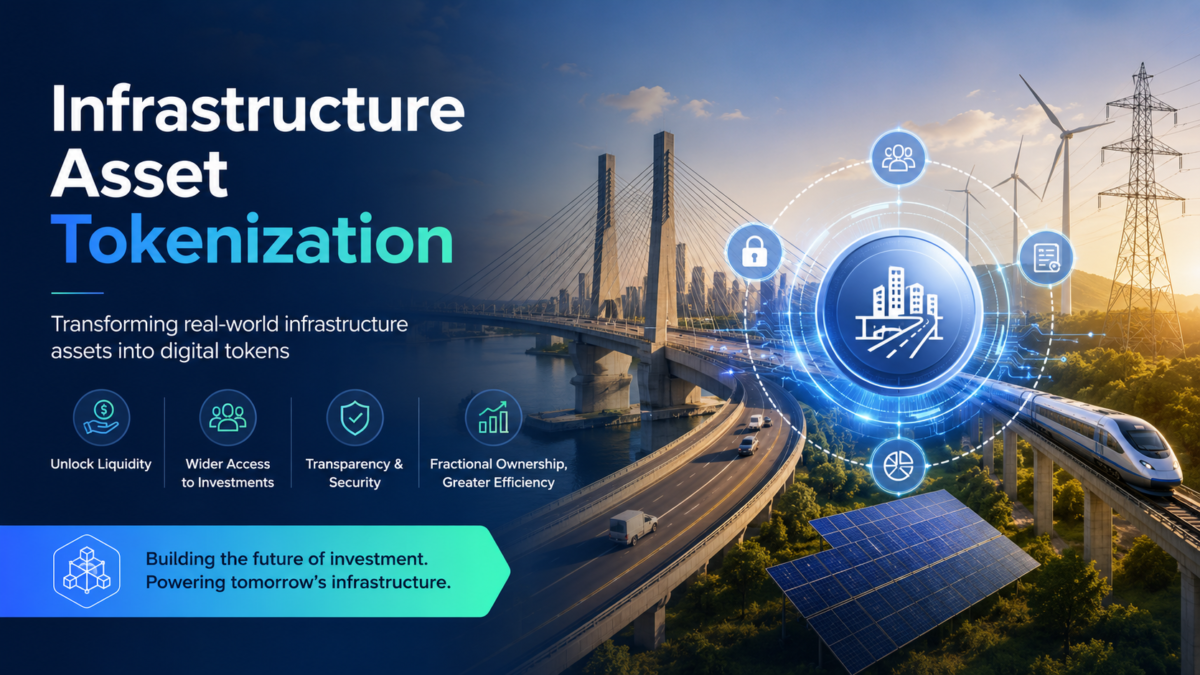

Infrastructure assets have traditionally been viewed as stable, long-term investments capable of generating predictable revenue streams. Roads, airports, energy grids, ports, railways, telecom towers, and water systems form the backbone of economic activity across nations. However, despite their importance, infrastructure investments have historically remained difficult to access, highly illiquid, and heavily dependent on institutional financing structures.
Infrastructure asset tokenization is changing this model by introducing digital ownership frameworks powered by blockchain technology. Through tokenization, large infrastructure assets can be digitally divided into smaller ownership units that are tradable, transparent, and programmable. This transformation is modernizing both public and private capital markets by improving liquidity, increasing investor accessibility, enhancing transparency, and enabling more efficient capital allocation.
As digital finance ecosystems continue to evolve in 2026, infrastructure asset tokenization is becoming a key bridge between traditional finance and blockchain-enabled investment systems.
Understanding Infrastructure Asset Tokenization
Infrastructure asset tokenization refers to the process of converting ownership rights or revenue rights associated with infrastructure projects into digital blockchain-based tokens. These tokens represent fractional interests in physical infrastructure assets or the cash flows generated by them.
The tokenized structure allows investors to purchase smaller portions of infrastructure investments instead of committing large amounts of capital to entire projects. Ownership records, transaction histories, and revenue distributions are securely managed through blockchain networks and smart contracts.
Infrastructure assets commonly being tokenized include:
- Renewable energy facilities
- Commercial transportation systems
- Toll roads and highways
- Airports and seaports
- Data centers and telecom infrastructure
- Water treatment and utility systems
- Industrial logistics hubs
This model introduces flexibility and efficiency into markets that have historically been capital-intensive and operationally rigid.
Why Traditional Infrastructure Financing Faces Challenges
Before understanding the impact of tokenization, it is important to recognize the limitations of conventional infrastructure financing systems.
Infrastructure projects typically require massive upfront capital investments and long development cycles. Funding usually comes from governments, institutional investors, pension funds, or private equity firms.
These structures create several challenges:
- Limited participation from retail investors
- Long lock-in periods for capital
- Complex legal and administrative procedures
- High transaction and management costs
- Lack of liquidity in secondary markets
- Slow settlement and ownership transfer systems
As global infrastructure demand increases, traditional funding models are struggling to meet the scale and speed required for modernization.
Infrastructure tokenization addresses many of these inefficiencies.
How Tokenization Modernizes Public Capital Markets
Public capital markets are increasingly integrating digital asset frameworks to improve market efficiency and broaden investment participation. Infrastructure asset tokenization plays a major role in this evolution.
Increased Accessibility for Investors
Traditional infrastructure investments have largely been restricted to institutional participants due to high capital requirements. Tokenization lowers these barriers by enabling fractional ownership. Retail investors can now gain exposure to infrastructure projects with smaller investment amounts. This democratizes access to an asset class previously dominated by large financial institutions.
Broader accessibility creates:
- Expanded investor participation
- Diversified funding sources
- Increased market activity
- Greater financial inclusion
This shift significantly changes how infrastructure capital is raised and distributed.
Enhanced Liquidity in Infrastructure Markets
Infrastructure assets have historically been considered illiquid because selling ownership stakes often requires lengthy negotiations and regulatory approvals. Tokenization introduces secondary trading opportunities where digital ownership units can be exchanged more efficiently on regulated marketplaces.
This enhanced liquidity offers:
- Faster investor exits
- Continuous price discovery
- Dynamic portfolio management
- Reduced capital lock-up periods
As liquidity improves, infrastructure investments become more attractive to a wider range of market participants.
Real-Time Transparency and Reporting
Blockchain infrastructure enables transparent and immutable recordkeeping. Every ownership transfer, revenue distribution, and transaction history can be securely verified on-chain. This transparency improves trust across public capital markets and reduces information asymmetry.
Benefits include:
- Transparent asset performance tracking
- Improved investor confidence
- Easier regulatory auditing
- Reduced fraud and operational disputes
Public infrastructure financing becomes more accountable and data-driven through tokenized systems.
Faster Settlement Processes
Traditional infrastructure investment transactions can take days or weeks to settle due to intermediaries and manual verification processes. Smart contracts automate these operations by executing transactions once predefined conditions are met.
This results in:
- Reduced administrative delays
- Lower transaction costs
- Automated compliance workflows
- Near-instant ownership transfers
Faster settlement mechanisms increase overall market efficiency.
How Tokenization Modernizes Private Capital Markets
Private capital markets are also experiencing major changes through infrastructure tokenization. Digital asset systems are introducing new fundraising models and operational structures for private infrastructure investments.
Improved Capital Formation
Infrastructure tokenization enables project developers to raise funds from a global investor base rather than relying solely on institutional lenders or private equity firms.
This diversified capital formation process supports:
- Faster fundraising cycles
- Reduced dependence on centralized financing institutions
- Expanded global investment participation
- More resilient funding ecosystems
Private infrastructure projects gain greater flexibility in accessing capital.
Fractional Ownership Structures
Tokenization allows infrastructure assets to be divided into smaller investment units. Investors can participate in portions of projects rather than committing to entire assets.
This fractionalization improves capital efficiency and portfolio diversification.
Examples include:
- Partial ownership in renewable energy farms
- Revenue-sharing rights in toll road systems
- Fractional participation in telecom infrastructure networks
This model increases investment flexibility within private markets.
Automated Revenue Distribution
Infrastructure projects often generate recurring revenues through tolls, energy production, leasing agreements, or service fees. Smart contracts automate the distribution of these revenues to token holders based on predefined ownership structures.
Advantages include:
- Transparent payment systems
- Reduced operational overhead
- Real-time revenue allocation
- Lower administrative costs
Automation improves efficiency and reduces reliance on manual financial management systems.
Integration With Digital Financial Ecosystems
Tokenized infrastructure assets can integrate with decentralized finance ecosystems and digital lending platforms.
These assets may eventually be used for:
- Collateralized lending
- Yield-generating investment products
- Asset-backed digital securities
- Infrastructure-focused digital investment funds
This expands the utility of infrastructure investments beyond traditional ownership models.
Key Infrastructure Sectors Benefiting From Tokenization
Several infrastructure sectors are particularly well-positioned for tokenization due to their predictable revenue streams and long-term economic value.
Renewable Energy Infrastructure
Solar farms, wind energy facilities, and battery storage systems are increasingly being tokenized to support global clean energy initiatives.
Tokenization helps renewable energy developers:
- Raise capital more efficiently
- Attract international investors
- Distribute revenue transparently
- Scale projects faster
This supports the global transition toward sustainable energy systems.
Transportation Infrastructure
Roadways, ports, airports, and logistics networks require continuous modernization and expansion.
Tokenized financing models provide:
- More efficient infrastructure funding
- Increased public participation
- Improved liquidity for infrastructure investors
- Flexible financing for expansion projects
Transportation systems benefit from more scalable capital allocation.
Telecom and Digital Infrastructure
The growing demand for digital connectivity is increasing investment in telecom towers, fiber networks, and data centers. Infrastructure tokenization enables scalable financing structures for rapidly expanding digital ecosystems. This is especially relevant in regions undergoing major digital transformation initiatives.
Regulatory Considerations in Infrastructure Tokenization
As infrastructure assets become digitized, regulatory frameworks are evolving to address ownership rights, investor protection, and compliance standards.
Key regulatory considerations include:
- Securities classification of infrastructure tokens
- Cross-border investment compliance
- Investor identity verification requirements
- Tax reporting obligations
- Governance and voting rights structures
Clear regulatory frameworks will play a critical role in determining the pace of adoption across global markets.
Challenges Facing Infrastructure Asset Tokenization
Despite its advantages, infrastructure tokenization still faces several challenges.
Regulatory Fragmentation
Different jurisdictions apply varying rules to digital assets and securities, creating complexity for international projects.
Technology Integration
Legacy infrastructure financing systems may struggle to integrate with blockchain-based platforms.
Market Education
Many traditional investors remain unfamiliar with tokenized investment structures and blockchain operations.
Cybersecurity Risks
Digital platforms handling infrastructure investments must maintain strong security protocols to protect investor assets and sensitive financial data.
Addressing these issues is essential for long-term market stability.
The Future of Infrastructure Tokenization
Infrastructure asset tokenization is expected to become a major component of global capital markets over the next decade. As blockchain infrastructure matures and regulatory clarity improves, tokenized infrastructure investments could become increasingly mainstream.
Future developments may include:
- Global digital infrastructure investment exchanges
- AI-powered infrastructure asset management systems
- Cross-border tokenized infrastructure funds
- Smart city financing ecosystems powered by tokenization
- Programmable infrastructure investment products
These innovations could significantly reshape how infrastructure is financed and managed worldwide.
Conclusion
Infrastructure asset tokenization is modernizing public and private capital markets by transforming traditionally illiquid infrastructure investments into more accessible, transparent, and efficient digital assets. Through fractional ownership, automated revenue systems, enhanced liquidity, and blockchain-based transparency, tokenization is creating new opportunities for investors, governments, and infrastructure developers alike. As adoption accelerates, infrastructure tokenization is likely to play a central role in the evolution of global capital markets, enabling more scalable and inclusive financing models for the critical infrastructure systems that support modern economies.
Leave a Comment