

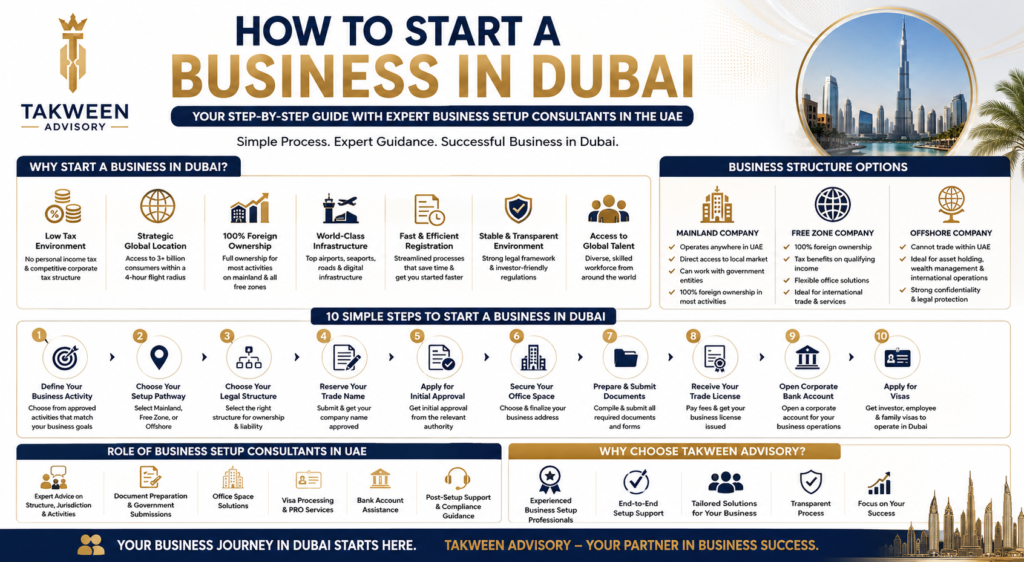
Dubai has built one of the most attractive business environments in the world. Low taxes, strategic location between East and West, world-class infrastructure, and a government that actively encourages foreign investment – these are not just selling points. They are the reasons why tens of thousands of entrepreneurs and investors choose Dubai every single year to launch and grow their businesses.
But knowing Dubai is a great place to start a business and actually understanding how to start a business in Dubai are two different things. If you are wondering how can I start a business in Dubai, the process involves multiple decisions, government authorities, documentation requirements, and regulatory steps that vary based on your business activity, nationality, and target market.
This guide covers the complete picture – from choosing the right business structure to understanding costs, working with business setup consultants in the UAE, and getting your company operational as efficiently as possible.
Why Start a Business in Dubai?
Before diving into the process, it helps to understand what makes Dubai stand out as a business destination.
Zero Personal Income Tax
The UAE does not levy personal income tax. Business owners and employees keep their full earnings, which makes Dubai highly competitive for attracting talent and retaining profits.
Low Corporate Tax
The UAE introduced a federal corporate tax of 9% in 2023, but it only applies to profits above AED 375,000. Businesses operating within qualifying free zones may benefit from 0% corporate tax on qualifying income under the free zone regime.
100% Foreign Ownership
Reforms introduced in 2021 removed the long-standing requirement for foreign businesses to have a UAE national partner for most mainland activities. Foreign entrepreneurs can now own 100% of their mainland company in most sectors, as well as in all free zones.
Strategic Global Location
Dubai sits at the crossroads of Europe, Asia, and Africa. It provides access to a consumer market of over 3 billion people within a four-hour flight radius. For trading, logistics, and services businesses, this location is unmatched.
World-Class Infrastructure
Dubai International Airport is one of the busiest in the world. Jebel Ali Port is the largest in the Middle East. The city’s road networks, digital infrastructure, and business facilities consistently rank among the best globally.
Fast Business Registration
Dubai has invested heavily in streamlining its business registration processes. With the right preparation and guidance, a business can be registered and licensed within a matter of days.
Stable and Transparent Legal Environment
The UAE operates a clear legal framework for business, with dedicated courts for commercial disputes and a regulatory environment that gives investors confidence. Political stability adds another layer of security for long-term business planning.
Understanding Business Setup in Dubai: The Three Main Pathways

When you start a business in Dubai, the first and most important decision is where and how to set it up. There are three main pathways, each with distinct advantages depending on your business model.
1. Mainland Company Setup
A mainland company is licensed by the Department of Economic Development (DED) and allows you to operate anywhere in the UAE – including with government entities, retail customers, and mainland businesses – without restrictions on where you can trade.
Mainland setup is ideal for businesses that want maximum market access, including retail shops, restaurants, construction companies, healthcare providers, and service businesses targeting the local UAE market.
Since the 2021 ownership reforms, most mainland activities permit 100% foreign ownership. Some restricted sectors – such as defence, security, and certain professional services – still require a UAE national partner or agent.
Best for: Businesses serving UAE mainland customers, retail and hospitality, professional services, government contractors.
2. Free Zone Company Setup
The UAE has over 40 free zones, each offering 100% foreign ownership, tax benefits, and streamlined registration processes within a specific geographic or sector-defined boundary.
Free zone companies are ideal for businesses focused on international trade, services export, technology, financial services, commodities trading, and any operation that does not primarily require direct access to the UAE mainland retail market.
Each free zone has its own regulatory authority, license types, and fee structures. Choosing the right free zone for your specific activity is critical – the wrong choice can result in higher costs, activity restrictions, or limitations on your visa allocation.
Popular free zones include DMCC (Jumeirah Lakes Towers), JAFZA (Jebel Ali), DIFC (financial services), Dubai Internet City (technology), and IFZA (cost-effective multi-sector option).
Best for: Trading companies, professional services exporters, technology firms, financial services, startups, and international businesses.
3. Offshore Company Setup
An offshore company in the UAE – typically registered through JAFZA or RAK ICC – is a legal entity that cannot conduct business within the UAE but can hold assets, open bank accounts, and operate internationally. It is primarily used for wealth management, asset protection, holding structures, and international tax planning.
Best for: Asset holding, international trade structures, wealth management, and investment vehicles.
Choosing the Right Business Structure
Within each pathway, you also need to choose a legal structure. The most common options are:
Sole Proprietorship (Sole Establishment): A single-owner business where the owner and the business are the same legal entity. Simple and low cost, but the owner carries unlimited personal liability. Available to UAE nationals for all activities and to foreign nationals for professional service activities only.
Limited Liability Company (LLC): The most common structure for mainland businesses. Shareholders are liable only up to their capital contribution. Suitable for most commercial activities and offers strong credibility with banks and corporate clients.
Free Zone Limited Liability Company (FZ-LLC): The equivalent of an LLC within a free zone. Provides limited liability protection and supports 1 to 50 shareholders depending on the free zone.
Free Zone Establishment (FZE): A single-shareholder free zone company. Ideal for solo investors or holding structures that want simplicity and full control.
Branch of a Foreign Company: Allows an existing international business to extend operations into Dubai without creating a separate legal entity.
Civil Company: Used for professional activities such as law, medicine, engineering, and accounting where the business is operated by licensed professionals.
The right structure depends on your ownership arrangement, the nature of your business activity, your liability preferences, and your growth plans. Getting this decision right at the start prevents expensive restructuring later.
How to Start a Business in Dubai: Step-by-Step

Step 1: Define Your Business Activity
Every business in Dubai must be registered for specific, approved activities. The DED and each free zone authority maintain lists of thousands of approved activities, each categorised and coded. Your activity determines your license type, any additional regulatory approvals required, and which setup pathway is appropriate.
Be specific. Vague or broad activity descriptions can cause complications during licensing. If you plan to offer multiple services, confirm upfront whether they can be combined under one license or whether multiple licenses are needed.
Step 2: Choose Your Setup Pathway and Jurisdiction
Based on your activity and target market, decide between mainland, free zone, or offshore. Then, if choosing a free zone, select the specific free zone that best suits your sector, budget, and operational requirements.
This decision has long-term implications for your costs, visa quota, market access, and tax position. It is worth taking the time – or getting expert guidance – to get it right.
Step 3: Select Your Legal Structure
Choose between an LLC, sole proprietorship, FZ-LLC, FZE, or branch structure based on your ownership arrangement and liability preferences.
Step 4: Reserve Your Company Name
Submit your proposed trade name for approval. In Dubai, trade names must comply with naming regulations – they cannot duplicate existing businesses, include offensive or religious terms, or imply government affiliation. Most authorities allow you to submit up to three name options.
Once approved, the name reservation is valid for a limited period. Complete the remaining steps before it expires.
Step 5: Apply for Initial Approval
Initial approval confirms that the relevant authority has no objection to the establishment of your business. This is a mandatory step before proceeding with full documentation, tenancy contracts, and final licensing.
Step 6: Secure Your Office Space
A registered business address is required for all business licenses in Dubai – whether mainland, free zone, or branch. Office options vary widely from virtual desks and co-working spaces to dedicated private offices and warehouses.
Your office choice directly affects your visa quota. Plan your workspace based on your current team size and expected headcount for the first year.
Step 7: Prepare and Submit Your Documentation
Compile all required documents – passport copies, visa pages, proof of address, business plan, shareholder agreements, corporate records, and any sector-specific approvals. Ensure all foreign documents are properly attested and translated where required.
Document preparation is where most delays occur. A thorough checklist reviewed by an experienced consultant prevents missing documents from pushing back your timeline.
Step 8: Pay Fees and Receive Your License
Submit your full application, pay the applicable license and registration fees, and receive your trade license. With your license issued, your company is officially registered and authorised to operate.
Step 9: Open a Corporate Bank Account
A corporate bank account is essential for any business operating in Dubai. UAE banks require your trade license, company documents, shareholder information, and in many cases a detailed business plan and projected revenue statements.
Bank account opening timelines vary – from a few days with digital banks to several weeks with traditional banks. The strength of your documentation and the clarity of your business profile are the biggest factors in how quickly accounts are approved.
Step 10: Apply for Visas
With your license and office lease confirmed, apply for investor and employee residency visas. This process includes medical fitness tests, Emirates ID registration, and visa stamping. Each visa typically takes 2 to 4 weeks to complete.
The Role of Business Setup Consultants in the UAE
Group of indian business man in suits sitting at office on cafe with laptop, texting on phones and making photo of coffee.[/caption]
Starting a business in Dubai involves navigating multiple government authorities, each with their own portals, document requirements, timelines, and fee structures. For most entrepreneurs – especially those doing it for the first time or setting up remotely from outside the UAE – working with experienced business setup consultants in the UAE makes the difference between a smooth launch and a costly, delayed one.
What Business Setup Consultants Do
A qualified business setup consultant in the UAE handles every stage of the registration process on your behalf. This includes advising on the right structure and jurisdiction for your specific business, preparing and reviewing all documentation, submitting applications and following up with government authorities, coordinating office space and tenancy documentation, managing visa applications and Emirates ID processing, and assisting with corporate bank account opening.
Beyond the setup itself, good consultants provide honest, specific advice rather than generic recommendations. They flag potential issues before they become problems, give you accurate cost expectations with no hidden surprises, and keep your process moving without you having to chase every step.
Why It Matters
The UAE has over 40 free zones, multiple mainland licensing authorities, and a regulatory environment that changes periodically. Choosing the wrong jurisdiction, filing incomplete documents, or missing a step in the process can add weeks to your timeline and thousands of dirhams in amendment fees.
A business setup consultant with deep UAE experience pays for themselves many times over through time saved, mistakes avoided, and faster market entry.
What to Look for in a UAE Business Setup Consultant
Not all consultants offer the same quality of service. When evaluating your options, look for a proven track record with specific numbers – how many companies they have set up, client satisfaction data, and verifiable reviews. Transparency on pricing matters too; reputable consultants provide detailed cost breakdowns upfront, not vague estimates followed by surprise fees.
Industry-specific knowledge is also important. A consultant who understands the requirements for a tech startup is better placed to help than one who primarily handles trading license applications. Look for someone who asks detailed questions about your business before recommending a structure – cookie-cutter advice rarely produces the right outcome.
Takween Advisory has completed over 500 successful business setups across Dubai’s free zones and mainland, with a 99% client satisfaction rate and an average setup time of 10 business days when documents are in order. The team provides clear, step-by-step guidance and full cost transparency from the first consultation.
Business Setup Costs in Dubai: What to Expect
Costs vary significantly depending on your chosen structure, jurisdiction, and office type. Here is a realistic overview to help you plan.
Mainland Company Setup
- DED license fee: AED 10,000 to AED 25,000 per year
- Office space: AED 15,000 to AED 60,000+ per year depending on size and location
- Initial approval and registration fees: AED 1,000 to AED 3,000
- Document attestation: AED 1,000 to AED 5,000
- Investor visa: AED 4,000 to AED 7,000 per person
Typical total first-year cost: AED 25,000 to AED 60,000
Free Zone Company Setup
- Registration and license fee: AED 10,000 to AED 25,000 per year (varies by free zone)
- Office space (flexi-desk to private office): AED 10,000 to AED 80,000+ per year
- Investor visa: AED 4,000 to AED 7,000 per person
- Document attestation: AED 1,000 to AED 5,000
Typical total first-year cost: AED 20,000 to AED 60,000
Key Cost Drivers
The biggest variables in your total setup cost are your office space choice and the number of visas required. These two factors alone can double or halve your total first-year expenditure. Plan both carefully based on your actual operational needs rather than minimum requirements.
Common Business Types and Best Setup Options in Dubai
Consulting or Professional Services: Free zone (DMCC, IFZA, or Meydan) or mainland sole establishment/LLC. Free zone is often faster and cheaper; mainland is better if you need direct access to UAE corporate clients.
E-Commerce: Free zone with an e-commerce license (Dubai CommerCity, SHAMS, or IFZA) or mainland LLC with an e-commerce activity.
Trading and Import-Export: JAFZA, DMCC, or mainland LLC with a trading license. JAFZA is the strongest for companies needing direct port access.
Technology and IT: Dubai Internet City, DMCC, or IFZA. Dubai Internet City offers a strong tech community and ecosystem benefits.
Financial Services: DIFC or ADGM for regulated financial activities. Both have their own legal frameworks and regulatory bodies.
Retail or F&B: Mainland LLC through DED. Free zone companies cannot operate retail outlets directly accessible to the general UAE public.
Healthcare: Mainland license with DHA or DOH approval depending on emirate. Healthcare requires sector-specific regulatory clearance beyond the standard trade license.
Mistakes to Avoid When Starting a Business in Dubai
Choosing jurisdiction based on cost alone – The cheapest free zone is not always the right one. Activity restrictions, visa limitations, and market access matter more than saving a few thousand dirhams on the license fee.
Underestimating total setup costs – Many first-time business owners budget for the license fee only. Office rental, document attestation, visa fees, and bank account requirements add significantly to the first-year total. Build a complete picture before you start.
Not verifying activity approvals – Certain activities require additional approvals from sector regulators beyond the standard trade license. Financial services, healthcare, education, and legal advisory are common examples. Missing these approvals delays your ability to operate even after your license is issued.
Rushing the bank account process – UAE banks have become more thorough in their due diligence. A weak business plan, unclear revenue model, or incomplete documentation can result in rejections or months of delays. Prepare your banking documents as carefully as your license application.
Ignoring post-setup compliance – A trade license requires annual renewal. Visas expire. VAT registrations need timely returns. Businesses that treat compliance as an afterthought face fines, license suspension, and visa complications that are expensive and disruptive to fix.
Frequently Asked Questions (FAQs)
Q1: How long does it take to start a business in Dubai?
With all documents in order and the right guidance, a business can be registered in Dubai in as little as 3 to 10 business days depending on the structure and jurisdiction. Mainland setups through the DED can sometimes be completed in 3 to 5 days. Free zone registrations typically take 5 to 10 days. Activities requiring additional regulatory approvals take longer.
Q2: Can a foreigner own 100% of a business in Dubai?
Yes. The 2021 mainland ownership reforms allow 100% foreign ownership for most business activities. Free zones have always permitted 100% foreign ownership. A small number of restricted mainland activities still require a UAE national partner, but these are exceptions rather than the rule.
Q3: What is the minimum investment required to start a business in Dubai?
There is no single minimum investment figure – it depends on the structure and jurisdiction. A simple free zone setup with a flexi-desk can cost as little as AED 15,000 to AED 25,000 for the first year. Mainland setups with physical office space and multiple visas can cost AED 40,000 to AED 80,000 or more. Regulated activities often require additional capital requirements set by sector regulators.
Q4: Do I need to be physically present in Dubai to register a company?
Not for most of the process. Documentation preparation, application submission, and approvals can largely be handled remotely. However, corporate bank account opening, visa applications, and Emirates ID processing typically require physical presence in Dubai.
Q5: What is the difference between a mainland and free zone company in Dubai?
A mainland company can trade anywhere in the UAE including directly with retail customers and government entities. A free zone company operates within a designated zone and is best suited for international trade, service exports, and businesses that do not need direct UAE retail market access. Free zone companies can trade with mainland businesses but typically need to work through a mainland distributor or agent for direct retail sales.
Q6: Do I need a business setup consultant to start a company in Dubai?
It is not legally required, but it is highly recommended – especially for first-time entrepreneurs or those setting up remotely. The UAE has multiple jurisdictions, changing regulations, and specific document requirements. An experienced consultant prevents costly mistakes, saves significant time, and provides clarity on costs that would otherwise take weeks of independent research to piece together.
Q7: What taxes apply to businesses in Dubai?
The UAE has no personal income tax. Corporate tax of 9% applies to annual business profits exceeding AED 375,000. Qualifying free zone businesses may be eligible for 0% corporate tax on qualifying income. VAT at 5% applies to most goods and services for businesses with annual taxable turnover above AED 375,000. Some sectors including healthcare, education, and financial services have specific VAT treatment.
Q8: Can I start a business in Dubai without living there?
Yes. Many foreign investors register companies in Dubai without residing in the UAE. You do not need to live in Dubai to own a company there. However, if you want a UAE residency visa through your business, you will need to spend time in the UAE for visa processing and renewals.
Q9: What is the role of business setup consultants in the UAE?
Business setup consultants in the UAE guide entrepreneurs through the full registration process – from choosing the right structure and jurisdiction to preparing documents, submitting applications, coordinating office space, and managing visa applications. A good consultant also advises on banking, compliance, and post-setup requirements. They save time, reduce errors, and help you avoid the pitfalls that slow down first-time business registrations.
Q10: How do I choose the right business setup consultant in the UAE?
Look for verifiable experience with a proven track record of completed setups, transparent pricing with detailed cost breakdowns, knowledge of your specific industry or activity type, and clear communication throughout the process. Avoid consultants who give vague estimates, promise unrealistically fast timelines, or push you toward a structure without understanding your business first.
Final Thoughts
Starting a business in Dubai is one of the most rewarding entrepreneurial decisions you can make. The market is open, the infrastructure is excellent, the tax environment is favourable, and the government continues to introduce reforms that make it easier for foreign investors to participate.
But getting the setup right matters. The decisions you make in the first few weeks – about structure, jurisdiction, activity classification, and office space – shape your costs, your market access, and your operational flexibility for years to come.
Working with experienced business setup consultants in the UAE gives you the clarity and guidance to make those decisions confidently, register efficiently, and focus your energy on building your business rather than navigating bureaucracy.
Takween Advisory offers a free consultation to walk you through your options with no obligation. Whether you are choosing between mainland and free zone, comparing jurisdictions, or trying to understand your total costs before committing, the team provides honest, specific answers grounded in real UAE setup experience.
Leave a Comment